What Are the Biggest Retirement Planning Lessons From 30 Years of Advising Retirees?

The short answer
In “30 Years of Retirement Knowledge in 20 Minutes,” Jeremy Finger, CFP®, shares five lessons from three decades of retirement planning. Retirement spending tends to follow a curve, not a straight line. Social Security timing should be a deliberate decision. Coordinating income sources can keep a retiree’s average tax rate low. Withdrawal order affects how long savings last. A stress-tested plan with margin is what lets someone move forward.
Why do retirement calculators overestimate how much you need to retire?
Jeremy explains that most online calculators take a retiree’s annual spending, add about 3% inflation each year, and project it in a straight line for 30 years. Jeremy’s position is that real retirement spending follows a curve he calls the spending smile, and that flat projections can overstate how much a retiree needs to save.
In his description, spending is highest in the active 60s, levels off in the 70s, and declines in the 80s as activity slows. With clients, he models that curve by front-loading income in the early years and tapering it later.
He describes a client, age 62 with about $1.4 million saved, whom online calculators told he needed $1.8 million. Using the spending smile instead of flat spending, Jeremy found the client’s existing savings already covered his plan, so the three extra working years were unnecessary.
When should you take Social Security: at 62, full retirement age, or 70?
Jeremy calls Social Security timing the one decision that can add or cost a retiree $100,000 or more. Claiming at 62 reduces the benefit by about 30% compared with full retirement age, and each year of delay past full retirement age adds about 8% until age 70. Jeremy’s rule is to make Social Security timing a decision, not a default.
He is clear that waiting until 70 is not right for everyone. Someone who needs the income or is in poor health may reasonably claim earlier. The planning question he poses is whether savings can cover expenses for a few years, a bridge, while the benefit grows.
He describes a couple, both 64, with about $900,000 saved. In their plan, delaying the higher earner’s benefit to 70 and the spouse’s to 67 added almost $200,000 in projected lifetime income without saving more or spending less. Hypothetical projection. Actual results depend on longevity and other assumptions.
How do some retirees pay less than 10% in federal income taxes?
Jeremy says he regularly sees retirees paying 6% to 8% in total federal taxes, while many workers pay 25% to 35% or more. He attributes the gap to coordination rather than luck: retirees gain access to added deductions, and drawing income from several account types can keep the average rate in single digits. None of these tax breaks happen automatically; Jeremy stresses that they only work when income is structured to use them.
He separates the marginal rate, paid on the last dollar of income, from the average rate, the share of total income that goes to tax. He lists what changes at retirement: a higher standard deduction after 65, a new $6,000-per-person deduction under the One Big Beautiful Bill Act, and potential 0% federal tax on long-term capital gains below a threshold. His method blends pre-tax IRA, Roth, brokerage, and Social Security income to fill the lowest brackets first.
He describes a retired client with about $1.2 million who pulled $80,000 a year from his traditional IRA alone. That pushed him into the 22% bracket, made 85% of his Social Security taxable, and raised his Medicare premiums. After withdrawals were restructured across his IRA, Roth, and brokerage accounts, Jeremy says the client’s federal tax bill fell by over $7,000 that year.
For South Carolina residents, Social Security benefits are exempt from state income tax, and taxpayers 65 and older may deduct up to $10,000 of qualifying retirement income, within a combined $15,000 age-65 deduction.
What order should you withdraw from retirement accounts?
Jeremy explains that where money comes from in retirement matters as much as how much is taken. Spending a brokerage account first lets pre-tax IRAs keep growing until required minimum distributions begin at 73. Those larger distributions can push retirees into higher brackets, make more Social Security taxable, and raise Medicare premiums. For many of the people he works with, Jeremy typically recommends drawing on pre-tax accounts in the lower-bracket early retirement years while leaving the Roth untouched.
He acknowledges the conventional order of taxable, then tax-deferred, then Roth can be fine in some cases. He calls the Roth the most flexible tool a retiree has: withdrawals are tax-free, it does not count toward provisional income or trigger IRMAA surcharges, and it has no RMDs. He wants it available for late-life expenses such as a new roof, a medical bill, or help for a grandchild.
He describes a couple in their early 70s, retired eight years, with over $1.8 million in IRAs and RMDs near $75,000 a year. With their pension, that made 85% of their Social Security taxable and cost an extra $2,400 a year in Medicare premiums. Jeremy estimates earlier, strategic IRA draws could have left balances near $1.1 to $1.2 million and RMDs near $45,000. Hypothetical comparison.
How do spending, Social Security, taxes, and withdrawal order work together?
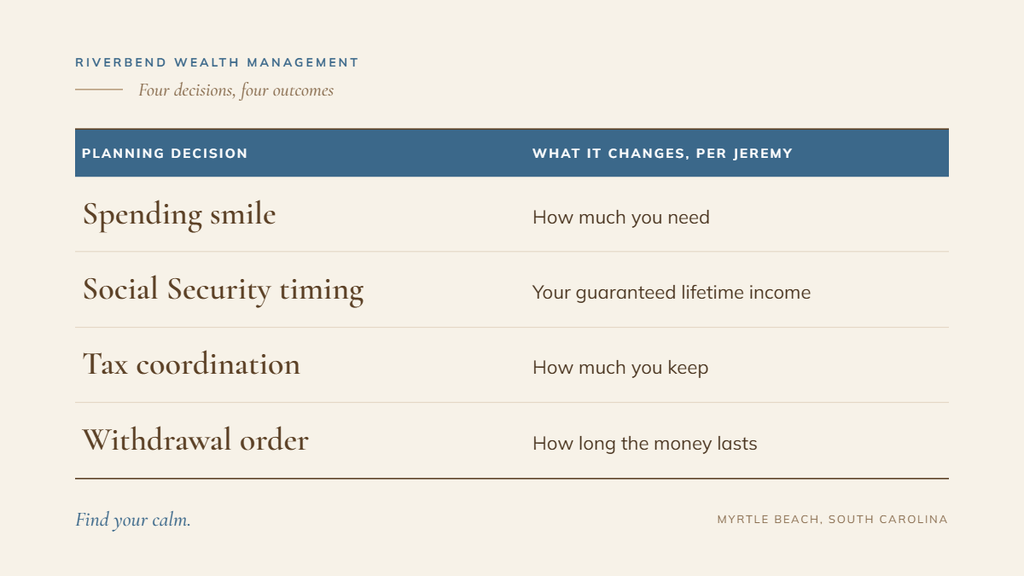
Jeremy ties the first four lessons into one sequence. In his summary, the spending smile changes how much you need, Social Security timing changes your guaranteed income, tax planning changes how much you keep, and withdrawal order changes how long it all lasts.
What does Jeremy tell everyone who is about to retire?
Jeremy’s message is that the largest risk in retirement is running out of time, not money. He has watched people delay for years, waiting for markets to settle, a little more savings, or a feeling of readiness, until a health change closed the window. His guidance is to prepare for what is possible rather than everything possible: stress-test the plan for market crashes, healthcare costs, and a long life, build in margin, then move forward.
He describes a 61-year-old client with about $1.6 million whose plan held up under every scenario he worried about, yet he kept delaying. The client retired three months after Jeremy asked him what he was waiting for. Jeremy closes by saying the money is the tool and the life is the point.
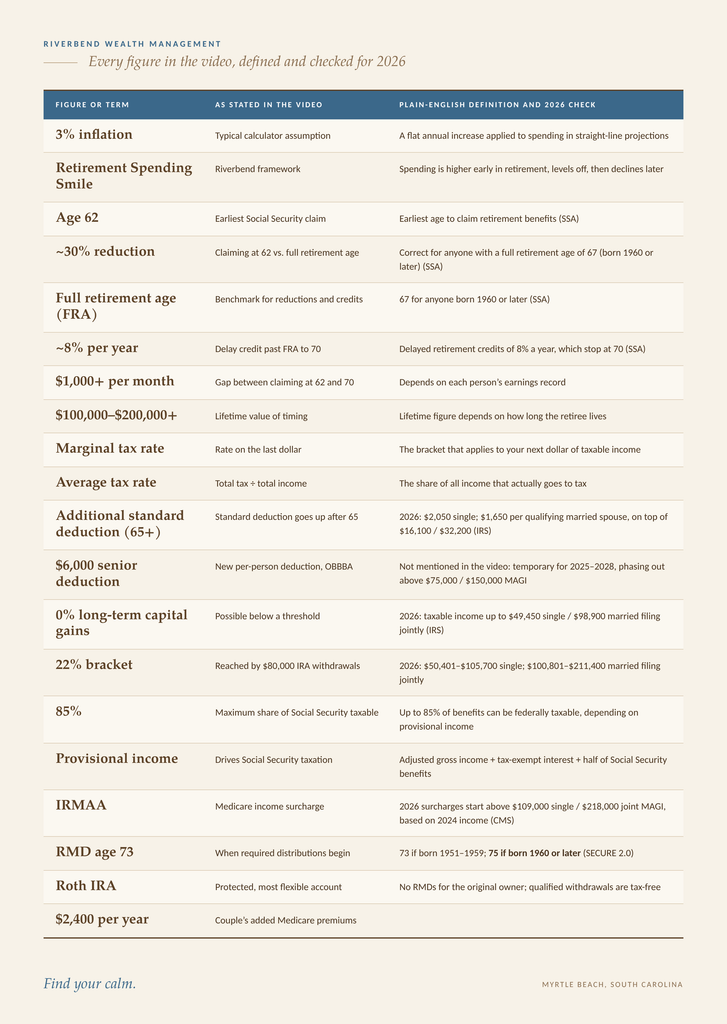
Key numbers and terms
Frequently asked questions
Jeremy says it usually does. In his spending smile, spending is highest in the active 60s, levels off in the 70s, and declines in the 80s. Calculators that assume flat spending, rising only with inflation, can overstate the savings a retiree needs. He models this curve instead of a straight-line projection.
No. Jeremy says waiting is not one-size-fits-all: someone who needs the income or has poor health may claim earlier. His point is to make the choice deliberately by comparing benefits at 62, 67, and 70 and checking whether savings can bridge the gap while the benefit grows.
Real financial planning for real life.
Riverbend is a fee-only, fiduciary advisor. Our plans are personal, shaped by your values and designed to help you build a full life.
Who We AreThe marginal rate is what you pay on your last dollar of taxable income, such as the 24% bracket. The average rate is the share of your total income that goes to tax. Jeremy explains that a retiree can sit in a higher marginal bracket while the average rate stays in single digits.
He calls the Roth the most flexible account a retiree has. Withdrawals are tax-free, it does not count toward provisional income or trigger IRMAA, and it has no required minimum distributions. He wants it available in the late 70s and 80s for unexpected costs such as a roof, a medical bill, or a grandchild.
Jeremy explains that the IRA keeps growing untouched until required minimum distributions begin. Large RMDs can then push a retiree into higher brackets, make up to 85% of Social Security taxable, and raise Medicare premiums through IRMAA. He calls this the tax bomb that can arrive in a retiree’s 70s.
Jeremy says yes, if income is structured correctly. Long-term gains in a brokerage account can be taxed at 0% when taxable income stays below the threshold. For 2026, that threshold is $49,450 for single filers and $98,900 for married couples filing jointly, according to IRS inflation adjustments.
Jeremy’s answer is margin rather than certainty. He stress-tests a plan against market crashes, healthcare costs, and living longer than expected. Once the plan can handle those, he encourages people to move forward instead of working one more year, because waiting has its own cost in time.
Subscribe to Jeremy’s YouTube channel for more retirement planning videos. Get the free 7 Retirement Mistakes to Avoid in Your 50s and 60s email course. When you’re ready, schedule a conversation with our Myrtle Beach team.