The Best Retirement Accounts Aren’t One-Size-Fits-All: How to Pick the Right Ones for You
You’ve probably heard you should be saving in “the best” retirement account. But here’s the honest answer most articles skip: there isn’t one.
The best retirement accounts depend on you—your income, your tax situation, whether you have an employer plan, and whether you own a business. The right account for your neighbor might be the wrong fit for you. So instead of crowning a single winner, let’s walk through how these accounts actually work, who each one tends to fit, and how good planning ties them together.
The short version: how folks often prioritize
There’s a rough order a lot of people use when they’re deciding where to put their savings. Think of it as a general starting point, not a rule—your situation could flip it around.
1. Capture your full employer match first. If your employer matches part of what you put in your 401(k) or 403(b), that match is part of your pay. Skipping it leaves money behind.
2. Then look at tax-advantaged accounts that fit you—a Roth or traditional IRA, or putting more into your workplace plan.
3. Consider an HSA if you’re eligible (more on this “stealth” retirement account below).
4. Then build flexibility with a taxable brokerage account—what we call a Freedom Account, because it isn’t locked behind retirement-age rules.
Where you land in that order really does depend on your tax bracket today versus where you expect it to be later. That’s exactly the kind of thing worth mapping out with an advisor.
Workplace plans: 401(k), 403(b), and 457(b)
These are accounts you get through an employer. A 401(k) is offered by many private companies. A 403(b) is the version for schools, hospitals, and nonprofits. A 457(b) is common for state and local government workers.
The big draws are higher contribution limits than IRAs and, often, an employer match. Many plans let you choose traditional (tax-deferred) or Roth (after-tax) contributions.
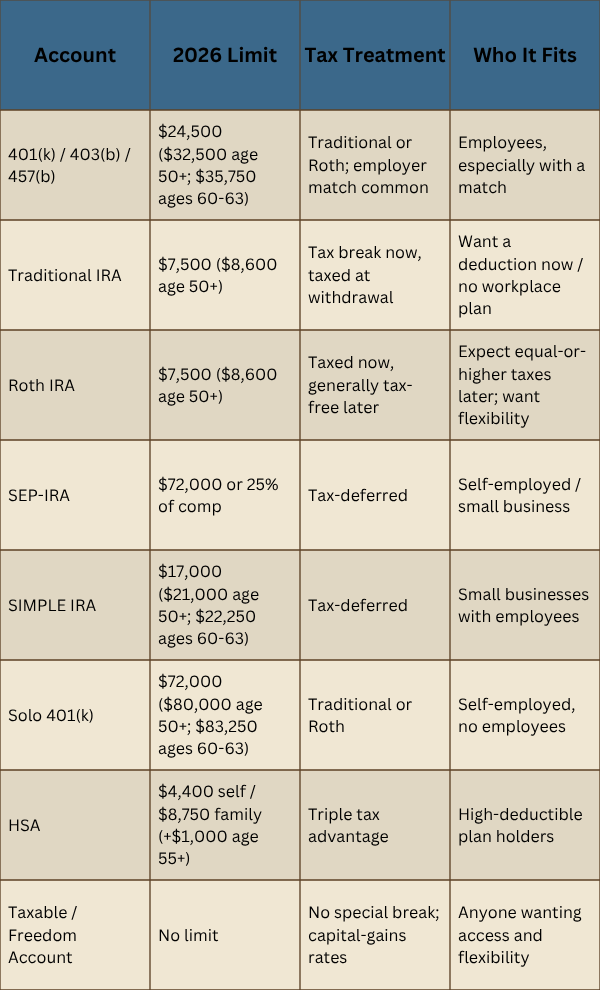
For 2026, you can contribute up to $24,500. If you’re 50 or older, you can add another $8,000 in catch-up contributions, for a total of $32,500. And thanks to SECURE 2.0, if you’re between ages 60 and 63, you get a higher “super” catch-up of $11,250—bringing your total to $35,750.
One more thing for folks who’ve changed jobs: when you leave an employer, you can often roll an old 401(k) into an IRA to keep things in one place. That’s called a rollover IRA.
Who they tend to fit: just about any employee, especially when there’s a match.
Source: IRS.gov, IR-2025-111
Traditional IRA
An IRA—Individual Retirement Account—is one you open on your own, outside of work.
A traditional IRA is usually tax-deferred: you may get a deduction the year you contribute, and you pay taxes when you withdraw. Whether you can deduct it depends on your income and whether you’re covered by a workplace plan.
For 2026, you can contribute up to $7,500, or $8,600 if you’re 50 or older.
Don’t forget the non-working spouse. They can contribute to their own IRA. I see so many people miss this.
Who it tends to fit: people who want a tax break now, or who don’t have a workplace plan.
Source: IRS.gov, IR-2025-111; IRS Publication 590-A
Roth IRA
A Roth IRA flips the tax timing. You pay taxes on the money now, and qualified withdrawals later are generally tax-free—growth included. There are no required withdrawals during your lifetime, which makes Roth dollars handy for both retirement income and leaving money to family.
For 2026, you can contribute up to $7,500 ($8,600 if you’re 50 or older)—same as a traditional IRA.
There’s a catch: higher earners may be limited or shut out of contributing directly. For single filers and heads of household, the income phase-out range is $153,000 to $168,000. For married filing jointly, it’s $242,000 to $252,000.
Who it tends to fit: people who expect to be in the same or a higher tax bracket later, and folks who want tax-free flexibility down the road. This ties into a concept we lean on a lot—“filling the lower tax brackets early.” The idea is to pay some tax now, while your rate may be lower, so you owe less later. It’s worth a conversation, not a guess.
Source: IRS.gov, IR-2025-111
Accounts for business owners and the self-employed
If you own a business or do 1099 work, you’ve got some of the highest-contribution options out there.
SEP-IRA. Simple to set up. Lets you contribute up to 25% of compensation, with a maximum of $72,000 for 2026. A good fit for solo owners or those with few employees.
SIMPLE IRA. Built for small businesses with employees. For 2026, you can contribute up to $17,000, plus a $4,000 catch-up if you’re 50 or older. If you’re between 60 and 63, the catch-up jumps to $5,250.
Solo 401(k). For business owners with no employees (other than a spouse). You contribute as both the employee and the employer, which can mean a total of up to $72,000 for 2026—or $80,000 if you’re 50 or older, and $83,250 if you’re between 60 and 63.
Defined benefit / cash balance plans. For high-earning owners who want to set aside even larger amounts—the annual benefit limit is $290,000 for 2026. These get complex fast.
Who they tend to fit: business owners—especially those eyeing an exit who want to lower today’s tax bill while building retirement savings.
Source: IRS Publication 560 (2026)
The HSA: the “stealth” retirement account
Here’s one people overlook. A Health Savings Account (HSA) is meant for medical expenses, but it can double as a retirement account—and it’s the rare account with a triple tax advantage: money goes in pre-tax, grows tax-free, and comes out tax-free for qualified medical costs. You need a qualifying high-deductible health plan to contribute.
For 2026, you can contribute up to $4,400 for self-only coverage or $8,750 for family coverage. If you’re 55 or older, you can add another $1,000.
Real financial planning for real life.
Riverbend is a fee-only, fiduciary advisor. Our plans are personal, shaped by your values and designed to help you build a full life.
Who We AreWho it tends to fit: people with a high-deductible health plan who can pay current medical bills out of pocket and let the HSA grow. With health care being a major retirement expense, that growth can matter.
Source: IRS Revenue Procedure 2025-21
Taxable brokerage accounts (Freedom Accounts)
Last, the account with no special tax break but a lot of freedom. A taxable brokerage account—what we call a Freedom Account—has no contribution limits and no age rules. You can pull money out whenever you want. You’ll owe taxes on dividends and on gains when you sell, often at lower long-term capital gains rates (if investment held one year).
Who it tends to fit: nearly everyone, as a flexible complement to retirement accounts—especially for money you might need before traditional retirement age.
A quick side-by-side (2026 limits)
The real secret: it’s not the account, it’s the plan
Picking an account is the easy part. The harder — and more valuable — work is making them work together.
Most people focus on which account to open. But the bigger questions are: How do you use them? In what order? And how do the pieces connect?
A few examples:
How do you balance tax-deferred and Roth dollars? If everything is in a traditional 401(k), you could face a tax bomb when RMDs kick in. But if you over-convert to Roth, you might pay more tax than you needed to. The goal is to fill the lower brackets strategically over time.
Which accounts do you tap first in retirement? The old rule was “taxable first, then tax-deferred, then Roth.” But that’s not always right. Sometimes pulling from a mix — or doing Roth conversions in low-income years — leads to a lower lifetime tax bill.
How do required withdrawals affect your taxes? You generally must start taking RMDs at age 73. Under SECURE 2.0, that age increases to 75 starting in 2033. And one change worth noting — Roth 401(k)s and Roth 403(b)s no longer require lifetime RMDs. That makes Roth dollars even more valuable for long-term planning.
These aren’t questions you answer once. They shift as tax laws change, as your income changes, and as you get closer to retirement.
The accounts are the building blocks. The plan is what turns them into income you can actually live on.
Source: IRS.gov, Required Minimum Distributions FAQs; IRS Publication 560
Frequently asked questions
What is the best retirement account? There isn’t a single best one. The best retirement account for you depends on your income, your tax bracket now versus later, whether you have an employer match, and whether you own a business. For many employees, capturing a full employer match comes first; from there, the right mix varies.
Is a Roth or a traditional account better? It comes down to taxes. A Roth means paying taxes now for generally tax-free income later. A traditional account gives you a break now and a tax bill later. People who expect higher taxes down the road often lean Roth; those who want a deduction today may lean traditional. Many people use both.
What’s the best retirement account for a business owner? Business owners have strong options like a SEP-IRA, a SIMPLE IRA, a Solo 401(k), or even a defined benefit plan. The right one depends on your income, whether you have employees, and how much you want to set aside.
Can I have more than one retirement account? Yes. Many people have a workplace plan and an IRA, plus a taxable account for flexibility. You can contribute $24,500 to a 401(k) and $7,500 to an IRA in the same year (assuming you meet income requirements for deductibility or Roth eligibility). The limits are separate.
Where should I start? A common starting point is contributing enough to get any employer match, then building from there based on your tax picture. The order that’s right for you is worth mapping out with an advisor.
The bottom line
The best retirement accounts are the ones that fit your life and your plan—and then get used together the right way. Capture the match, mind the taxes, keep some flexibility, and revisit it as the rules (and your life) change.


