How Should You Withdraw From a Large IRA in Retirement?

The short answer
Tyler Batts explains that retirees holding large traditional IRAs often do better starting withdrawals early and spreading them evenly than waiting for required minimum distributions. Left untouched, the account keeps growing, so the forced withdrawals arrive larger, land on top of Social Security, and can push a retiree into a higher bracket and trigger a Medicare surcharge called IRMAA.
Why does leaving a large IRA untouched backfire?
A traditional IRA holds money that went in before tax, so every dollar withdrawn counts as ordinary income. Tyler explains that a large account left alone keeps compounding until the government forces withdrawals, which means the required amounts arrive bigger and compressed into a shorter stretch of life.
In the video, Tyler describes waiting as the move that feels responsible and often costs the most.
Those larger required withdrawals stack on top of Social Security. That combined income can push a retiree into a higher bracket, make more of their Social Security taxable, and trigger the Medicare premium surcharge known as IRMAA. His framing is that deferral does not remove the tax — it relocates it to a year with less room.
When do required minimum distributions start?
Required minimum distributions, or RMDs, are the withdrawals the IRS requires from pre-tax retirement accounts once a person reaches a set age, whether they need the money or not. Tyler gives the two thresholds in the video, and both come from the SECURE 2.0 Act.
Anyone born between 1951 and 1959 has an RMD age of 73; anyone born in 1960 or later has an RMD age of 75.
The distinction matters for how long the low-tax window runs. Someone born in 1962 who retires at 65 has a full decade before the first required withdrawal.
What happens if a retiree with $1.5 million waits until RMDs begin?
Tyler walks through a hypothetical retiree named Carol. She is 66, recently retired, holds $1.5 million in a traditional IRA, has Social Security starting soon, and keeps a small amount in savings. Her instinct is to protect the IRA and pay no tax until she has to.
In Tyler’s illustration, Carol’s untouched IRA grows to roughly $2.25 million by 75, and her first required withdrawal comes to about $90,000 — money she did not want to take.
At 75 the IRS formula requires roughly four percent of the prior year-end balance, and the required amount climbs each year after. That $90,000 lands on top of Carol’s Social Security, putting her well over $100,000 of income in her mid-seventies. Tyler’s point is that she is paying top dollar on a withdrawal she did not choose.
This is a hypothetical illustration for education, not a projection. It assumes a rate of return that is not guaranteed, and individual results vary.
What changes when the same retiree starts nine years earlier?
Tyler reruns the same case with one change: starting at 66, Carol takes deliberate, modest withdrawals every year through 75. Those are her naturally low-income years, before a paycheck is replaced and while there is room in the lower brackets.
She takes enough each year to use up the lower brackets without tipping into a higher one, paying tax on purpose at a low rate.
By 75 the account is meaningfully smaller, so the required withdrawals are smaller too. In Tyler’s illustration they do not spike her bracket or trigger the Medicare surcharge, and her income stays smooth for the rest of her life. He describes the difference as the same IRA and the same retirement, managed rather than deferred.
Which years are the best window to withdraw from a large IRA?
The first lever Tyler names is timing. The years between retiring and the start of RMDs are usually the lowest-income years a retiree will ever have — no paycheck, and possibly no Social Security yet if the claim has been delayed.
That gap is the cheapest window to move money out of a pre-tax IRA, and Tyler’s view is that most retirees let it pass unused.
For someone retiring at 65 with an RMD age of 75, that is a ten-year runway. The width of the window is set by two choices the retiree controls: when they stop working, and when they turn on Social Security.
What does “filling the brackets” mean in practice?
The second lever is deliberate bracket management. Tyler frames it as taking enough from the IRA each year to use up the lower brackets, and stopping before the next one starts.
The target is not the largest possible withdrawal — it is the largest withdrawal that still stays inside the low bracket.
He describes it as accepting the government’s low-rate offer while it is available, rather than leaving it on the table and being forced into high-rate withdrawals later. The right dollar figure changes every year as other income moves.
Do you have to spend what you withdraw from an IRA?
No, and Tyler names this as the point where retirees most often get stuck. Money can leave the pre-tax IRA without being spent, by moving into a Roth account instead.
A Roth conversion moves the money across, taxes it at today’s rate, and shrinks the balance that future required withdrawals are calculated from.
From there it grows tax-free and comes out tax-free in qualified distributions. Conversions also reduce the pre-tax balance the RMD formula is applied to, so the lever works on both ends.
How does giving directly from an IRA lower the tax bill?
The fourth lever applies to retirees who already give to charity. Starting at 70½, money can go straight from the IRA to a qualified charity.
A qualified charitable distribution is excluded from income entirely when the requirements are met, and once required withdrawals have begun, it counts toward that year’s RMD.
Tyler’s framing is that the money does good and lowers the tax bill in the same motion. Between 70½ and the RMD age there is no required withdrawal yet for a QCD to satisfy — the exclusion from income is the benefit in those years.
Can you draw down a large IRA too quickly?
Yes, and Tyler is explicit that none of this argues for emptying the account fast. Pulling too much in a single year pushes a retiree into high brackets today, which defeats the purpose of the whole exercise.
The approach he describes is measured and even — filling the low brackets year after year, not draining the account at once.
How much is right depends on the retiree’s other income, their other accounts, and their goals. That is the reason he points viewers toward running their own numbers rather than applying a rule of thumb.
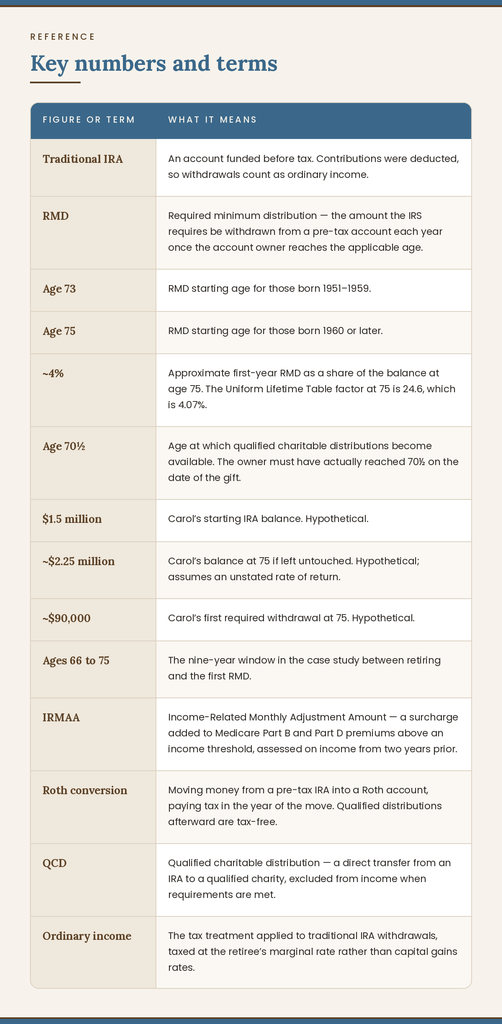
Key numbers and terms
Real financial planning for real life.
Riverbend is a fee-only, fiduciary advisor. Our plans are personal, shaped by your values and designed to help you build a full life.
Who We AreNo. Tyler presents conversions as a way to move money out of a pre-tax IRA without spending it, and separately describes RMDs as withdrawals the government requires. Once a retiree has reached RMD age, the required amount must be taken before any conversion happens. Conversions reduce future required withdrawals rather than satisfying the current one.
Because the rate matters more than the timing. In the video, the retiree who withdraws from 66 to 75 pays tax at low rates in years with room, instead of at high rates on larger forced withdrawals later. Tyler’s framing is that deferral does not remove the tax, it moves it to a worse year.
Enough to use the lower brackets without crossing into a higher one. Tyler does not give a fixed percentage, and he warns directly against emptying the account quickly. The right figure depends on a retiree’s other income, their other accounts, and their goals, which is why he recommends running actual numbers.
IRMAA is a surcharge added to Medicare premiums once income passes a threshold. Tyler raises it because large required withdrawals landing on top of Social Security can push income past that line, meaning a forced withdrawal raises the tax bill and the Medicare premium at once.
Starting at 70½. Tyler explains that the gift goes straight from the IRA to the charity and is excluded from income when the requirements are met. Once required withdrawals have begun, a QCD also counts toward that year’s RMD.
Yes, if the withdrawals are too large. Tyler is explicit that drawing too much too fast pushes a retiree into high brackets today and defeats the purpose. The approach he describes is measured and even across many years rather than front-loaded.
If you’d like someone to run your own withdrawal numbers, book a discovery call with Riverbend.
Subscribe to Tyler’s channel for new retirement planning videos each week.
Or start with our free email course, 7 Retirement Mistakes to Avoid in Your 50s and 60s.