Tax Bracket Optimization: Smart Ways to Potentially Reduce Your Taxable Income
It’s not just what you make. It’s what you keep.
Nobody mails you a notice that says, you paid more tax than you had to this year. But it happens all the time — and for folks who’ve built up a healthy nest egg, the dollars left on the table can be real. The good news? A little planning can quietly fix a lot of it.
Tax bracket optimization simply means arranging your income and your deductions so more of your money is taxed at the lower rates — and less of it spills into the higher ones. You can’t control the tax code. But you have more control over your own tax bracket than you might think. Here’s how this generally works.
First, how tax brackets really work
A lot of people believe that earning one more dollar — or pulling a little extra from an IRA — bumps all of their income into a higher bracket. That’s the single biggest tax myth out there, and it’s worth clearing up.
The U.S. uses a marginal system. Your income fills up brackets like water filling buckets. Only the dollars that land in the next bracket get taxed at that higher rate — not everything underneath. So your marginal rate (the rate on your last dollar) is almost always higher than your effective rate (what you actually pay overall). For 2026, federal income tax brackets run from 10% to 37%, and the standard deduction is $16,100 for single filers and $32,200 for married couples filing jointly.
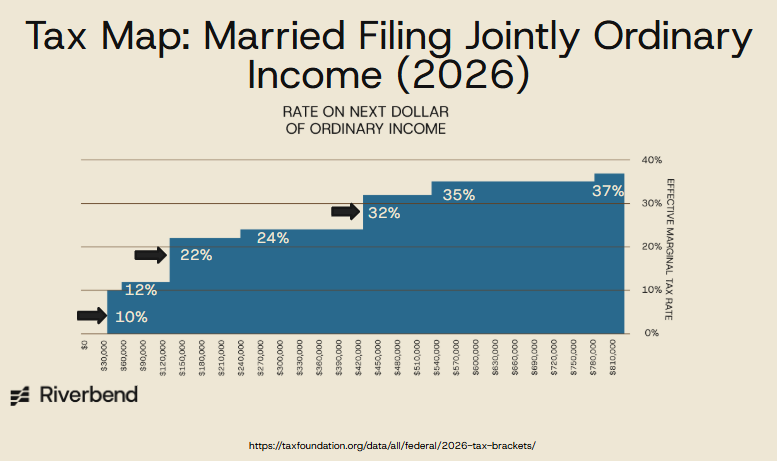
Here’s a hypothetical example, just to show the idea (not a real client, and only for illustration): if a married couple’s income pokes $5,000 into the next bracket, only that $5,000 is taxed at the higher rate — not their whole income. Once you really get that, a lot of smart moves open up.
Build three buckets, not one
The best setup for tax bracket optimization is having money in different tax buckets, so you can choose where your next dollar of income comes from. Broadly, there are three:
- Tax-deferred — traditional IRAs and 401(k)s. You got a deduction going in, but every dollar comes out as taxable income later.
- Tax-free — Roth IRAs and Roth 401(k)s. No deduction going in, but qualified withdrawals come out tax-free and don’t count as income.
- Freedom Accounts — that’s our name for your taxable and joint brokerage accounts, which get their own capital-gains treatment.
When you have all three, you can blend withdrawals in retirement to keep your taxable income in a comfortable range — instead of being forced to pull everything from one taxable source. That flexibility is the strategy.
Fill the lower brackets early
There’s often a sweet spot after you stop working but before Social Security and required withdrawals kick in. Your income dips, which means some of those lower brackets may be sitting there unused.
One way to use that window is a Roth conversion — moving money from a traditional IRA to a Roth and paying the tax now, on purpose, at today’s lower rate. We call this idea filling the lower tax brackets early, and it’s aimed at a real problem: the tax bomb. That’s the large future tax bill that builds up inside tax-deferred accounts. Once you reach age 73, the IRS requires you to start taking withdrawals — required minimum distributions, or RMDs — from those accounts, whether you need the money or not. Chipping away at that balance earlier, in low-income years, can mean smaller forced withdrawals — and a lower bracket — later.
A conversion adds to your income the year you do it, so the art is converting just enough to fill a bracket without spilling into the next one. This is general education, not a personalized instruction — the right amount depends on your full picture and is worth mapping out with your advisor.
Real financial planning for real life.
Riverbend is a fee-only, fiduciary advisor. Our plans are personal, shaped by your values and designed to help you build a full life.
Who We AreGive in a tax-smart way
If you’re charitably inclined, giving is one of the most powerful bracket tools there is — and it’s the Charitable Giving piece of our Bridge Method.
For retirees taking RMDs, a qualified charitable distribution (QCD) is hard to beat. You send money straight from your IRA to a charity, and it can count toward your RMD without landing in your taxable income at all. In 2026, you can give up to $111,000 per person directly from an IRA as a QCD, and you can start at age 70½.
Not yet taking RMDs? Two more ideas. Bunching means grouping several years of giving into one year so you clear the standard deduction and can itemize — often using a donor-advised fund, so you take the deduction now but spread the actual gifts out over time. And there’s a newer option for non-itemizers: starting in 2026, even if you take the standard deduction, you can deduct cash gifts to charity — up to $1,000 for single filers or $2,000 for married couples filing jointly.
If you’re 65 or older, don’t miss the senior deduction
For tax years 2025 through 2028, people who are 65 and older can claim an extra $6,000 deduction. It begins to phase out above $75,000 of income for single filers and $150,000 for joint filers, and you don’t have to itemize to take it. It can be especially handy in a year when a Roth conversion or another taxable event nudges your income up.
Still working or running a business? Use your accounts
For pre-retirees and business owners, the most reliable way to shrink this year’s taxable income is still to fund your tax-advantaged accounts. For 2026, you can put up to $24,500 in a 401(k) — plus an $8,000 catch-up if you’re 50 or older, or $11,250 if you’re between 60 and 63 — and up to $7,500 in an IRA, plus a $1,100 catch-up at 50 or older. A health savings account, if you’re eligible, is another quiet workhorse — money goes in pre-tax and comes out tax-free for qualified medical costs.
One heads-up worth a conversation: starting in 2026, higher earners generally have to make their catch-up contributions to a Roth instead of pre-tax — so that piece won’t lower this year’s taxable income.
Mind the calendar
Timing matters, too. If a big taxable event is coming — selling a property, a business, or a chunk of appreciated stock — it’s worth asking whether splitting it across two tax years keeps you in a lower bracket. The same logic runs the other way: bunching deductions, harvesting investment losses to offset gains, and choosing which year income lands in are all part of the same game.
Where this fits
All of this lives in the Tax Planning part of our Bridge Method — our five-part approach of investments, tax planning, estate planning, wealth protection, and charitable giving. And it’s worth saying plainly: Riverbend is a fee-only fiduciary. We’re legally required to act in your best interest, and we don’t earn commissions or sell products. When we help you think through your tax picture, we’re on your side of the table.
Tax bracket optimization isn’t about any single trick. It’s about steering your income, year by year, so you keep more of what you’ve worked so hard to build.