Medicare Planning in Retirement: How It Fits Your Whole Plan

Medicare isn’t something you sign up for at 65 and forget. What you earn in retirement decides what you will pay in the future. When you sign up can stick you with a penalty for life. And the plan you pick at 65 can box you in at 75. So Medicare needs a seat at the table with the rest of your retirement plan.
We’re right in the middle of open enrollment. It runs October 15 through December 7. Every year, people sit down, compare drug plans, pick one, and call it done.
That’s the part Medicare tells you about.
One thing to keep in mind is that the decisions that cost people the most money don’t only happen in open enrollment. They can happen on your tax return, and they can happen in how you pull money out of your accounts. Let me share with you what I mean.
Why does Medicare need to be part of your retirement plan?
Because healthcare is one of the biggest bills you’ll pay in retirement.
Fidelity looks at the numbers every year. Their 2026 estimate says a 65-year-old retiring this year will spend about $185,500 on healthcare over their retirement. For a couple, that’s around $371,000. And that doesn’t even count long-term care.
Here’s the part that gets people. About 45% of that is just your Medicare premiums for Part B and Part D. The rest is copays, deductibles, and the stuff Medicare doesn’t touch, like most dental, vision, and hearing.
Fidelity also found that 54% of people getting close to retirement think Medicare covers everything. It doesn’t. Not even close.
When do you need to sign up for Medicare?
You get a 7-month window. It opens 3 months before the month you turn 65 and closes 3 months after.
If you miss this window, your Part B premium can go up 10% for every full year you went without it. And that penalty doesn’t go away. You carry it for as long as you have Part B. That’s a long time to pay for a missed deadline.
Now there’s one big exception for people that are still working. If they are working for an employer with more than 20 employees, AND if they are on that employer’s health plan, they can usually wait to sign up for Medicare. Once that job or coverage ends, you’ve got 8 months to sign up with no penalty. Just know that COBRA and retiree health plans don’t count here.
And if you’ve got a Health Savings Account, there’s a unique rule for you. If you sign up for Medicare after 65, Part A can reach back up to 6 months. So you’ll want to stop putting money in your HSA at least 6 months before you apply. Otherwise you could owe a penalty.
What is IRMAA, and why should you care?
IRMAA is one of those government acronyms nobody can remember. It stands for Income-Related Monthly Adjustment Amount.
Here’s what it really means. If your income is high enough, you pay more for Medicare. Same coverage. Bigger bill.
In 2026, the standard Part B premium is $202.90 a month. If you’re married and file jointly, IRMAA starts once your income goes over $218,000. If you’re single, it’s $109,000.
Here’s how it shakes out for married couples this year:
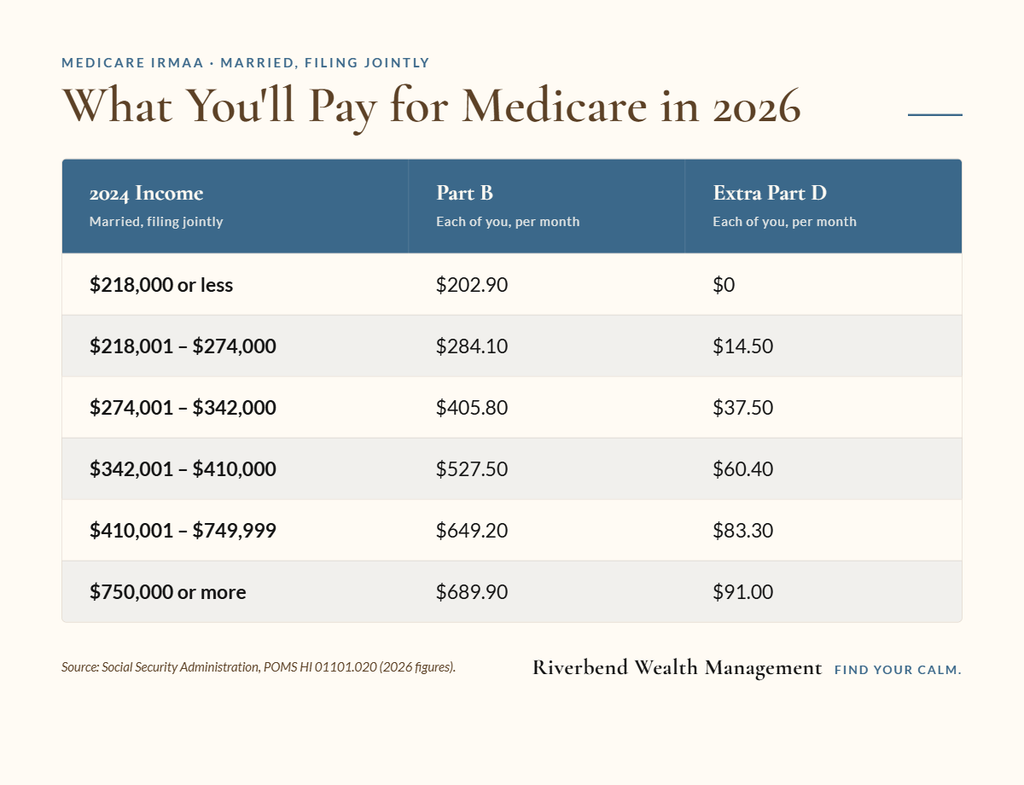
Here’s a couple things you need to keep in mind.
First, Medicare looks back 2 years. What you pay in 2026 is based on your 2024 tax return.
Second, these aren’t ramps. They are cliffs. Which means if you go over the line by $1, then you pay the full jump. A couple at $218,001 pays $2,296.80 more for the year than a couple at $218,000. One dollar difference in income = almost $2,300 in additional premiums. That’s the kind of thing that a little planning can completely avoid.
How do Roth conversions affect your Medicare bill?
This is where that 2-year lookback really gets you. If you do too large of a Roth conversion at 63, it shows up in your Medicare bills at 65.
That doesn’t mean Roth conversions should be taken off the table. It’s just about getting the timing and the amounts correct.
For people who retire before 63, this is a sweet spot where you have a lot of bracket space to work with. Your paycheck’s gone. Social Security and RMDs haven’t kicked in. And Medicare isn’t watching yet. For some people, that can be the biggest window of opportunity to fill lower tax brackets efficiently.
And in some cases it’s worth paying IRMAA for a year. If a bigger conversion now saves you from a tax bomb later, you might come out way ahead. There’s no rule of thumb for this one that applies across the board. You’re specific situation is going to be unique.
Also, make sure you look into the near future for events that can impact your plan. Selling a house. Selling a business. A big capital gain. Any of those can change your tax situation.
Which accounts should you pull from first?
This is where you’ve got more control than you think. Not every dollar you take out counts the same.
- Traditional IRA or 401(k): Every dollar counts as income.
- Joint / Individual accounts): Only the gain counts. Not the whole withdrawal.
- Roth accounts: Qualified withdrawals don’t count at all.
- Giving straight from your IRA to charity (QCDs): Once you hit 70½, those gifts don’t count as income. And once RMDs start, they can cover your RMD too.
Mix those the right way, and you can stay under a line while still spending what you want. That’s why I say your withdrawal plan and your Medicare plan should be coordinated.
What if your income drops when you retire?
This one catches a ton of people. You retire, your income falls off a cliff, and Medicare still bills you like you’re working. That’s because it’s looking at your last 2 paycheck years.
You don’t necessarily have to absorb that cost. Social Security counts retirement as a “life-changing event.” You might be able to file Form SSA-44 and ask them to use your new, lower income. Marriage, divorce, losing a spouse, and losing a pension count too.
Unfortunately, it’s very common for people to miss this opportunity.
Should you pick Medigap or Medicare Advantage?
Both can work. But this choice is a lot harder to undo than people think.
Medigap works alongside Original Medicare. You’ll pay more each month. But you can see any doctor who takes Medicare, and your costs are pretty predictable.
Medicare Advantage usually costs less each month, and may throw in some extras. The trade-off is you’ll usually stay in a network, and you’ll pay more as you use more care, up to a yearly cap.
Here’s the part that matters. When you first get Part B at 65 or later, you get a 6-month Medigap window. During that window, they can’t turn you down or charge you more because of your health.
Once that window closes, most states let insurers ask health questions. So if you go with Advantage at 65 and want to switch to Medigap at 75, you might not get in.
How can Medicare planning protect your spouse?
This is difficult to plan for, but crucial.
When one spouse passes, the one left behind usually starts filing single the year after. And the IRMAA line gets cut in half, from $218,000 to $109,000. But your income doesn’t necessarily get cut in half.
Here’s a simple example. A couple has $200,000 of income. They’re under the line, so they each pay the standard $202.90. One of them passes, and the survivor’s income drops to $160,000. The single line is much lower than the Married Filing Jointly line. Now the survivor’s Part B premium doubles to $405.80 a month. And their tax brackets get tighter at the same time.
The good news is you can plan for this. Roth conversions, withdrawal sequencing, and other planning beforehand can help prepare your financial setup to avoid this potential outcome.
Real financial planning for real life.
Riverbend is a fee-only, fiduciary advisor. Our plans are personal, shaped by your values and designed to help you build a full life.
Who We AreYour Medicare checklist, by age
55 to 62
- Put healthcare costs into your retirement income plan.
- If you’re retiring before 65, figure out how you’ll cover the gap.
- Map out your potential Roth conversion window.
63
- Remember, this year’s income sets your Medicare bill at 65.
64 to 65
- Circle your 7-month sign-up window.
- If still working, check whether your job’s coverage lets you wait on Part B.
- Stop HSA contributions 6 months before you apply, if you’re signing up late.
- Compare Medigap and Advantage before your Medigap window closes.
65 and up
- Look at your Part D plan every open enrollment.
- Check your income against the IRMAA lines every year.
- Talk to your CPA about filing Form SSA-44 if a big life change drops your income.
70½ and up
- Consider giving to charity straight from your IRA.
Quick answers to common Medicare questions
Does Medicare cover all my healthcare in retirement?
No. You’ll still pay premiums, deductibles, and copays. And Medicare doesn’t cover most dental, vision, hearing, or long-term custodial care.
What income counts for IRMAA?
Your modified adjusted gross income. That’s your adjusted gross income plus any tax-free interest, like municipal bond interest.
Can I lower my IRMAA bill?
Sometimes. Over the long run, smart withdrawals and well-timed Roth conversions help keep you under the cliffs we mentioned earlier. If you passed one of those cliffs already in a prior year, ask your CPA about filing Form SSA-44.
Do Roth withdrawals raise my Medicare premiums?
No. Qualified Roth withdrawals don’t count toward your income for IRMAA.
When will we know 2027 Medicare costs?
Part B premiums are projected to be $209.50 a month for 2027. Part D premiums are projected to be about $36.
I know there are a lot of moving parts, and this may feel overwhelming. It’s usually best to get all of your information organized, then talk to a professional Advisor or CPA who knows your particular situation, knows what your next best step really is, and looks at the whole picture for you.