How to Prepare Your Retirement Portfolio for Market Volatility

At some point, the market will go down. Possibly as much as 20% or more.
If you’ve recently retired right when that decline comes, the ground beneath your retirement plans might feel unsteady.
If history repeats, you know that markets should recover, but you don’t know when.
Meanwhile, the bills keep coming. So what do you do? Reduce your spending? Wait for a recovery? Go back to work? Sell investments to prevent further downside?
These are uncomfortable questions to think about.
But if you already have the answers, then there’s very little to be uncomfortable about.
First of all, sometimes we can make lemonade out of lemons.
When the market has a downturn, depending on your account types and some of the details inside those accounts, there can be tax-savings opportunities to take advantage of.
But before that even happens, you can prepare your portfolio in advance to be resilient against the next storm.
One of the simplest but most profound strategies is called the Waterfall.
Rather than viewing your investments as one large pool of money, imagine three connected layers.
One is short-term money that you will need relatively soon, within the next year or 2.
One is more medium term, about 2-5 years.
And the third is long-term, 5 years or more.
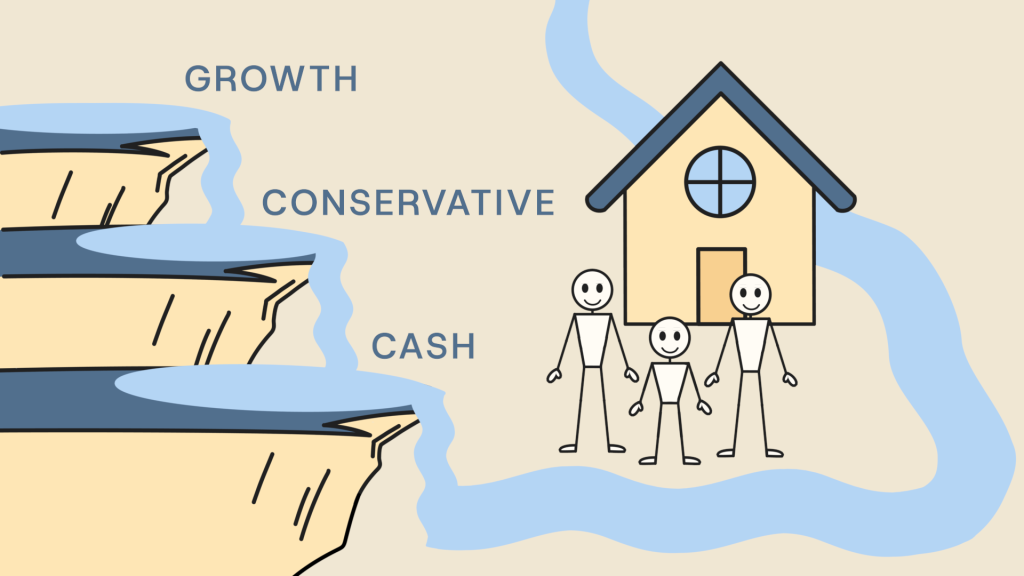
The Waterfall Strategy is a methodology that accomplishes several things:
- It properly categorizes your money into different timeframes
- It treats each category differently from a risk/reward perspective
- It allows money to flow smoothly from category to category through time
- It keeps your income consistent regardless of what happens in the market
The first layer: Cash and short-term reserves.
This is where your upcoming withdrawals will come from. This layer may include cash, Money Market, and other high-quality short-term holdings.
Several of the choices in this layer are called ‘cash equivalents’. They earn a yield helping to combat some inflation, but the main emphasis is on liquidity and stability rather than maximizing returns.
People who have little concern about volatility might only keep 3-6 months’ worth of withdrawals in this layer.
People who have a lot of concern about volatility might keep between 1-3 years’ worth of withdrawals in this layer.
Quick question: Did you know that most standard checking accounts are paying almost 0 interest, while Money Market funds and high yield savings accounts are paying about 3.5%? (And those funds are usually still available same day or next day)
As you use this layer for your income for your household, the amount will gradually deplete. So as that occurs, it will receive new funds from layer 2. The middle layer.
The middle layer: Income and relative stability.
This layer attempts to get more upside than layer 1, but still with some emphasis on overall stability.
It may include ‘fixed income’ with maturities in the 2-5 year range. The ‘fixed income’ portion can fluctuate some with interest rates and credit conditions, but overall they have stable value, especially if held until ‘maturity’.
Alongside that fixed income will be a healthy mix of value-oriented, dividend-paying investments. These assets pay income as well but also have some upside appreciation above and beyond that income.
These companies and funds can broadly be lumped into the ‘Value’ category.
This category of companies are not putting every dollar of potential profit towards growth. They are paying back their shareholders. They are focusing on the bottom line. They are emphasizing durability, resiliency, and responsibility.
Real financial planning for real life.
Riverbend is a fee-only, fiduciary advisor. Our plans are personal, shaped by your values and designed to help you build a full life.
Who We AreDuring downturns of the more speculative investments, it’s often these investments that shine. The reason that happens is because the market pendulum can swing from having a high-risk appetite to preferring stability and higher levels of certainty.
These assets certainly will go down at times as well, but they have a solid chance of being the more resilient batch of companies during volatile times.
The dividends, interest, maturing fixed income, and occasional sale of stocks from this layer is what will replenish the first layer as needed.
As the middle layer feeds some funds into the first layer, this layer will need to be replenished as well, which is why we have the third layer.
The third layer: Long-term growth.
The main objective of this portion of the portfolio is to grow over time and to serve your long-term needs. (Not your spending for this year, or next year, or even the year after that.)
Because this is long-term money, it has more time to weather the downturns.
Nobody loves volatility to the downside, but we all like volatility to the upside. And that’s why this layer plays an important role.
The assets in this layer are broadly categorized as ‘Growth’.
We still try to select quality companies that have a good chance of long-term success. But these companies differ from the prior layer. They usually aren’t paying dividends. They are in growth mode. They are hiring new people, testing new products, building out new locations, trying new things. They are the innovators.
Now with those attempts at innovation sometimes comes mistakes, bad judgment, risks, and failures.
Because of all that, there is more uncertainty in this category.
So the range of outcomes for these companies is quite wide.
Now that might sound pretty risky. But what we do is buy hundreds of these companies, so we are betting across multiple entrepreneurs, multiple industries, multiple technologies. We aren’t gambling on one potential outcome. We are betting that overall, the world will move forward with new ideas and innovations, and a good amount of those will be profitable new ventures at some point in the future.
In the past 25 years, if you avoided this layer out of fear, you would have missed out on some of the best upside of your lifetime.
This growth is what will feed into the prior 2 layers that we mentioned.
Now the right mix of the 3 layers will be unique to you.
It might be a 10% / 80% / 10% mix between the 3 layers
I’ve seen some folks prefer 33% / 33% / 34%
Others prefer 10% / 20% / 70%
It won’t be perfect, and it doesn’t have to be. This approach doesn’t require perfection, constant growth, or massive returns to work. This strategy along with a full financial plan is designed to go the distance.