Your 2026 Retiree Checklist: Tax-Smart Moves to Make Before December 31st

The best year-end tax moves for retirees in 2026 are filling low tax brackets with Roth conversions, giving to charity through qualified charitable distributions (up to $111,000 per person), harvesting losses or 0% gains in taxable accounts, and keeping income under the phaseout for the new $6,000 senior deduction. Most of these must be done by December 31.
Why does year-end tax planning matter more for retirees?
When you were working, your tax bill mostly took care of itself. Your paycheck set your income & your withholding was mostly automatic.
Retirement flips that. Now you have some control over how much income shows up on your tax return each year. Which accounts you pull from. When you sell. The amounts. The timing.
That control allows you to potentially take advantage of opportunities. But some of those opportunities have a deadline of December 31.
2026 is also the first full year under the new tax law passed in 2025, often called the One Big Beautiful Bill Act. Some rules changed in ways that reward planning. Here are ten moves worth checking before the year ends.
1. Should I do a Roth conversion before year end?
A Roth conversion moves money from a traditional IRA into a Roth IRA. You pay tax on it now. In exchange, that money can grow tax-free, and future withdrawals are generally tax-free too.
The key question to answer before the end of the year is : -How much are you willing to pay in taxes today if it means you might increase the odds of a lower lifetime tax bill?
For 2026, a married couple filing jointly stays in the 12% bracket up to $100,800 of taxable income. The 22% bracket runs up to about $211,400. Many retirees in their 60s are in a low-income window, after the paycheck stops but before Social Security and required minimum distributions kick in. That’s often the best time to convert.
Pay a little tax now at a known, lower rate, instead of a potentially bigger tax bomb later.
Two watch-outs:
- Medicare premiums. Higher income can raise your Medicare Part B and D premiums (called IRMAA) two years later. A 2026 conversion can affect your 2028 premiums. You can think of this as another bracket to pay attention to besides your standard tax bracket.
- The new senior deduction. More on that next. A conversion can shrink it.
Conversions must be completed by December 31 to count for 2026. Unlike IRA contributions, there’s no April extension.
2. How do I protect the new $6,000 senior deduction?
If you’re 65 or older, the new law gives you an extra deduction of up to $6,000 per person for 2025 through 2028. A married couple who both qualify can get up to $12,000. It stacks on top of your regular standard deduction and the existing extra amount for age 65.
But there’s a catch. It starts shrinking once your modified adjusted gross income passes $75,000 for single filers or $150,000 for joint filers. For every dollar over, you lose 6 cents of the deduction per person. It’s gone entirely at $175,000 single or $250,000 joint.
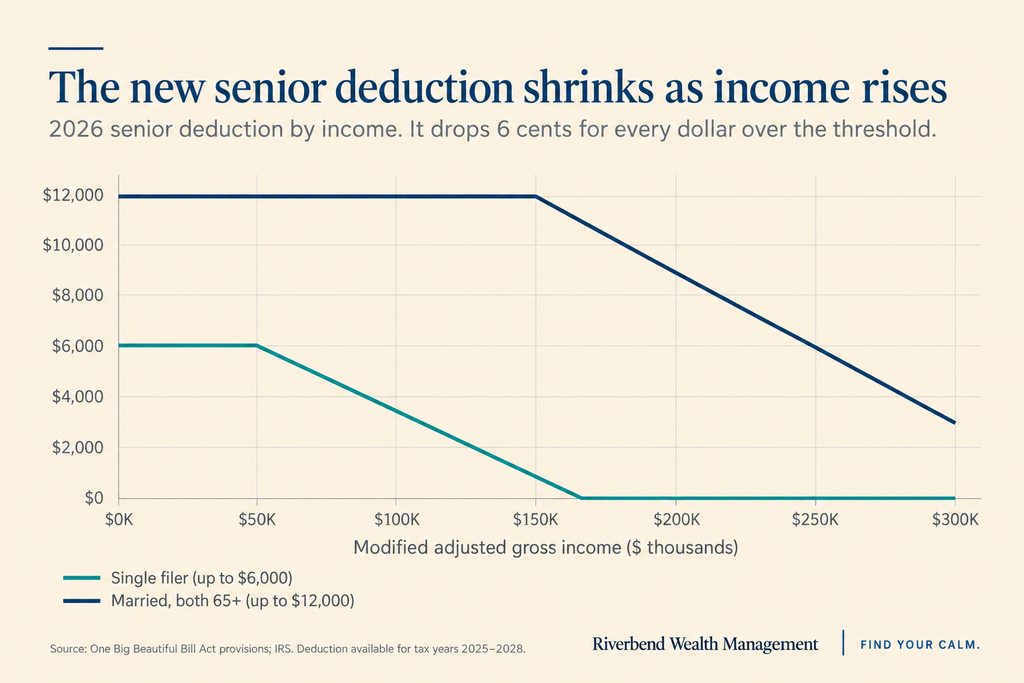
So before December 31, estimate your income. If you’re close to that line, you might time a conversion, a large IRA withdrawal, or a capital gain to stay under it. Or you might decide the conversion is still worth it.
3. Are qualified charitable distributions still worth it in 2026?
Yes. In fact, they may be more valuable than ever.
A qualified charitable distribution, or QCD, lets you give directly from your IRA to a charity once you’re 70½ or older. For 2026, the limit is $111,000 per person. The money never shows up in your income. And if you’re 73 or older, it counts toward your required minimum distribution.
Why this matters more now: starting in 2026, people who itemize can only deduct charitable gifts above 0.5% of their adjusted gross income. And people in the top 37% bracket get only 35 cents of tax benefit per dollar deducted. QCDs sidestep both of those limits because they keep the money out of your income to begin with.
Lower income can also help with the senior deduction and Medicare premiums. That’s a triple win from one move.
One tip: send the request to your IRA custodian early. The check has to leave your IRA by December 31, and custodians get busy in December.
4. Should I bunch charitable gifts this year?
If you don’t qualify for QCDs yet, you could still consider ‘bunching’. That means putting two or more years of giving into one year, often through a ‘donor-advised fund’, so you clear the standard deduction and itemize that year. Then you go back to taking the standard deduction in the off years.
New for 2026: if you take the standard deduction, you can still deduct up to $1,000 of cash gifts to charity, or $2,000 if married filing jointly. Gifts to donor-advised funds don’t qualify for this one. It has to go straight to the charity.
5. Can I sell investments at a loss to lower my taxes?
Yes. It’s called tax-loss harvesting. If an investment in a taxable account is worth less than you paid, you can sell it to lock in the loss. The loss offsets capital gains. If you have more losses than gains, up to $3,000 a year can offset ordinary income, and the rest carries forward.
Just watch the wash-sale rule. If you buy the same or a “substantially identical” investment within 30 days before or after the sale, the loss is disallowed.
Some of our clients use direct indexing, which owns individual stocks instead of a single fund. It can make it easier to find losses to harvest throughout the year, not just in December.
6. What is the 0% capital gains bracket for 2026?
This is one of the most overlooked tax breaks for retirees. In 2026, long-term capital gains are taxed at 0% federally if your total taxable income stays under $98,900 for married couples filing jointly, or $49,450 for single filers.
Remember, that’s taxable income, after your deductions. A married couple can have quite a bit more gross income and still land in the 0% zone.
Real financial planning for real life.
Riverbend is a fee-only, fiduciary advisor. Our plans are personal, shaped by your values and designed to help you build a full life.
Who We AreIf you have room, you can sell appreciated investments, pay no federal tax on the gain, and buy back in right away to reset your cost basis higher. This is called tax-gain harvesting. The wash-sale rule only applies to losses, not gains.
7. Have I taken my required minimum distribution?
If you’re 73 or older, you generally must take your RMD from traditional IRAs and most workplace plans by December 31. The penalty for missing this is pretty steep. (Up to 25% of the amount you should d have taken.)
If 2026 is the year you turned 73, you can delay your first RMD until April 1, 2027. But then you’ll take two RMDs in 2027, which can push you into a higher bracket. For most folks it’s better to take the first one now.
Also if you were born in 1960 or later, your first RMD year is at age 75, not 73.
Inherited IRAs have their own different rules. Many people who inherited an IRA after 2019 must take yearly withdrawals and empty the account within 10 years, but it’s case by case depending on who you inherited it from and what their RMD status was when they passed.
8. Have I maxed out my retirement contributions?
Still working? For 2026, you can put up to $24,500 into a 401(k), plus an $8,000 catch-up if you’re 50 or older. If you’re 60 to 63, the catch-up is even higher, $11,250. IRA limits are $7,500, plus a $1,100 catch-up at 50 and older.
One change to know: starting in 2026, higher earners (generally those who earned more than $150,000 in FICA wages the prior year) must make 401(k) catch-up contributions as Roth contributions.
401(k) contributions generally must come out of paychecks by December 31. IRA and HSA contributions can wait until the April tax deadline.
9. Should I make my annual gifts to family now?
You can give up to $19,000 per person in 2026 without filing a gift tax return. Which means a married couple can give $38,000 per person. That allowance doesn’t roll over. If you don’t use it by December 31, it’s gone for 2026.
We’ll cover gifting in depth in one of our next articles, including 529 plans, paying tuition and medical bills directly, and the new Trump accounts for kids.
10. Is my withholding on track?
Retirees often get hit with underpayment penalties because no employer is withholding for them. If you did a big conversion or sold a lot of stock this year, check your estimated payments.
Here’s a handy trick. Taxes withheld from an IRA distribution are treated as if they were paid evenly through the year, even if you take them in December. That can fix an underpayment problem in one step.
11. Bonus
… As we say all the time … coordinating all of the moving pieces together is the real key.
Join us for our webinar this week:
Don’t Blow the First 10 Years: Retirement Spending & Tax Strategies That Actually Work
Nov 17, 2026 12:00 PM EST